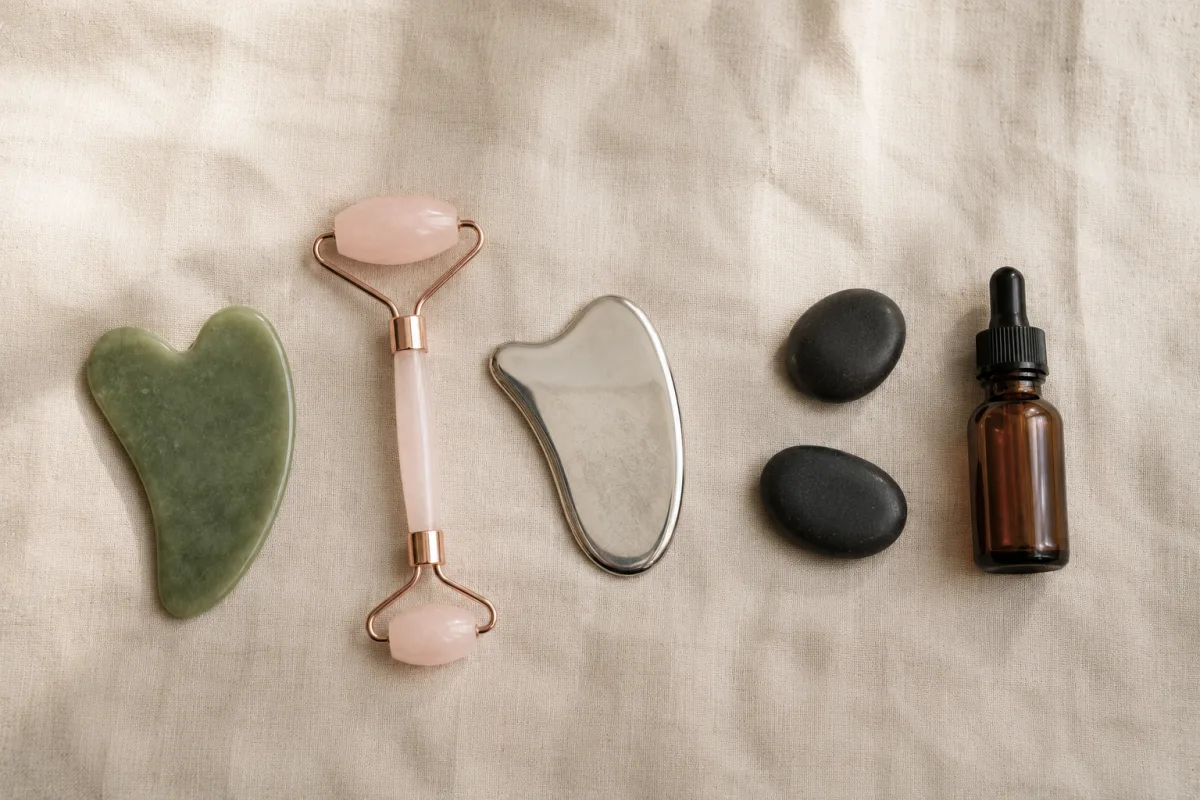
This is the starting point for at-home facial massage on Sereneyuto: what it actually does, where the techniques came from, how the tools differ, and when to leave your face alone. It’s for you if you’re still deciding whether any of this is worth your time, and which of the four or five options out there fits you.
You won’t find a promise of a new jawline. What you will find is a plain account of a low-risk habit with modest, mostly short-lived effects, and enough detail to pick one tool instead of buying four.
One thing to get out of the way first. Facial massage isn’t right for everyone. If you’ve had injectables or any cosmetic procedure recently, you’re dealing with active breakouts, or you take blood thinners, read when to skip it before you start.
What facial massage does, and what it doesn’t
Start with the honest version, because the category rarely leads with it.
Facial massage is mechanical. Pressure and movement across the skin and the muscle underneath can do a few things:
- Release muscle tension. Your jaw, temples and the muscle along the side of your face hold a lot of clenching. Working on them can help that tension let go, and it’s the effect people notice most reliably.
- Temporarily increase local circulation. Rubbing an area brings blood to it. That’s why skin often looks brighter or a little flushed right afterward, and why the effect fades within hours.
- Move fluid that pooled overnight. Eight hours lying flat lets fluid settle in your face. Gentle, directional strokes can encourage it to move on, which is why the clearest result most people get is less morning puffiness.
- Make a routine feel like something. The wind-down effect is real even when the cosmetic effect is small. For a lot of people that’s the actual reason they keep going.
Now the limits, stated just as plainly:
- It does not detoxify anything. The lymphatic system isn’t a drain, and a stone can’t empty it. Where you see that language, it’s marketing.
- It does not reduce facial fat. Nothing you do with your hands changes where your body stores fat.
- It is not an alternative to injectables. Muscle relaxants and fillers work on a completely different mechanism. Something that produces a change lasting a few hours isn’t competing with something that lasts months.
- It does not lift or reshape bone or connective tissue. Any change in contour you see is fluid. Fluid comes back.
If that shorter list still sounds worth 10 minutes a day, the rest of this page is for you.
What the research actually found
Most of what gets written about facial massage cites nothing at all. There is one decent trial worth knowing about.
A randomized controlled trial published in the Journal of Cosmetic Dermatology in 2025 put a flat gua sha stone against a facial roller. Thirty-three women aged 20 to 50 did ten-minute sessions, five days a week, for eight weeks. Three results matter:
- Contour: a tie. Both tools reduced facial surface distance by a similar amount, and the difference between them was not meaningful.
- Muscle tone: the stone. The flat stone reduced dynamic stiffness, which is the measure that corresponds to muscle letting go. The roller didn’t move it.
- Skin elasticity: the roller. The roller improved elasticity measures and the stone didn’t.
Now the caveats, because they matter as much as the findings. Thirty-three participants is a small trial. And the authors say directly that eight weeks was long enough to show a change, not long enough to know whether it lasts. This is one study, not a body of literature.
We work from product data and public customer feedback, and where the science isn’t there to support a claim, we say so instead of borrowing certainty it hasn’t earned. The full breakdown of that trial, including what each measurement means, is in the stone versus roller comparison.
Where these techniques come from
Two traditions account for most of what gets called facial massage online. Both deserve their real names instead of a generic wellness label.
Gua sha (刮痧) is a traditional Chinese practice, and the name describes exactly what it does: gua means to scrape, sha refers to the reddish marks that scraping raises. It was developed for the body, not the face. Practitioners worked it firmly along the back and limbs and brought up those marks on purpose. The facial version circulating today is a modern, far gentler adaptation: a smooth-edged tool, light pressure, no intention of marking the skin at all. It shares the tool and the name with the older practice. It doesn’t share the pressure or the purpose, and that’s worth saying out loud, because a recent reinvention doesn’t inherit the authority of a centuries-old one.
Diện chẩn is Vietnamese and much newer. Its own institutions, meaning the founder’s published biography and the international academy that teaches it, date its founding to 1980 in Ho Chi Minh City and credit it to Bùi Quốc Châu. That’s the provenance we can point to. We haven’t found an independent history of the method, and we’re not going to imply one exists. Its full name translates roughly as facial diagnosis and cybernetic therapy. The central idea is that specific points on the face map to other parts of the body, and that stimulating those points in sequence produces effects elsewhere. That’s a claim about physiology, and mainstream research hasn’t established it. We’re not going to present it as though it had. What we can say: a documented method, a named founder, a traceable start date. That’s more than most things sold as ancient can show you.
Rollers and facial cupping have shallower histories here. Jade rollers as sold today are largely a modern product category, and facial cupping is a light adaptation of body cupping. Neither carries the lineage the packaging implies.
Types of tools
Four approaches cover almost everything sold in this category. They’re not interchangeable, and the differences are bigger than the marketing suggests.
| Tool | Learning curve | Best for | Watch out for |
|---|---|---|---|
| Bare hands | None | Finding out whether you’ll stick with it | Skin drags on skin without a slip agent |
| Gua sha stone | Steepest | Jaw and temple tension | A wrong angle on dry skin drags and reddens |
| Roller | Gentlest | Puffiness and the eye area | The axle is the part buyers report failing |
| Hot stone | Moderate, plus setup | A slower weekend session | The only real burn risk in this category |
Bare hands. Costs nothing, needs no purchase, and gives you the most control over pressure and direction. Your fingertips also read what’s happening underneath better than any tool can, so you can feel where the muscle is tight. The drawback is grip, and it announces itself within about a minute. Skin drags on skin, so bare hands need more slip than any tool does, and holding steady pressure for ten minutes tires your fingers in a way a tool doesn’t. Not sure you’ll keep this up? Start here and buy nothing.
Gua sha stone. A flat tool, usually stone or stainless steel, with contoured edges for different parts of the face. It spreads pressure along an edge instead of a point, which suits long directional strokes down the jaw and across the cheekbone, and the material stays cool against skin. It also demands the most technique of the four. Edge angle and pressure both matter, and a tool used badly on dry skin will drag. If you’ve settled on a stone, our guide to choosing one by material and shape applies every criterion below to specific stones.
Roller. A rolling head on a handle, most often stone. It’s easier than a flat stone because the roller sets its own angle, so there’s much less to get wrong, and that makes it the most forgiving place to start. The trade-off is control. Pressure is lighter and harder to direct, so it suits gentle overall work and the eye area better than a tight jaw. Rollers also have moving parts, and the axle is what buyers most often report failing. Torn between the two? The head-to-head comparison covers what the trial measured for each.
Hot stone. Warmth added to the mechanical effect, which many people find makes tension release easier. It also brings the only real burn risk in this category. It needs a way to check the temperature instead of guessing, and the setup time makes it a weekend thing more than a daily one.
What to look for when choosing
Once you know which type you want, most of the decision is physical, and most of it is checkable before you buy.
Material. For stone tools, the practical differences are how long the material stays cool and how well it survives being dropped. Stainless steel reads cold the moment it touches your cheek, holds that cold longest, and won’t chip, and it’s also the least forgiving of a heavy hand. Softer stones start closer to neutral, warm up sooner, and chip more easily if you drop one. Choose on those properties, not on any claim about the energetic qualities of a crystal. That isn’t something anyone can compare.
Edge finish. This matters more than material and gets discussed less. A well-finished edge is smooth, with the flat face rolling into it through a gentle curve rather than a step. A poorly finished one has an abrupt transition, sometimes with a faint ridge left from grinding, and that ridge is what catches on skin and turns into redness. Photos almost never show it, so this is where reading the review pattern pays off. Repeated mentions of scratching or dragging usually mean edge finish, not user error.
Shape and size. Match the contours to your own face, not to the photograph. A deep notch lets the jawbone sit down inside the curve instead of skidding over it. A broad flat side is what you want for the cheek and forehead. Weight and dimensions are listed on most product pages, and buyers with small or large hands often say outright in reviews whether a tool suited them.
Build, for anything with moving parts. For rollers, look for how buyers describe the axle after a few months. For anything with a battery, look at what they say about charge life and whether the device still works a year on.
Ease of cleaning. Anything that goes on your face after sitting in a drawer needs washing, and some tools make that easier than others. Smooth, non-porous surfaces with no seams rinse clean in seconds, while oil that finds its way into a seam tends to stay there.
Price against value, not against a number. The useful question isn’t whether something is cheap, it’s whether it’s actually better than a comparable option costing less. Sometimes the answer is yes, and sometimes the extra buys packaging. We don’t list prices, because they change too often to state reliably, so check the current one at the retailer.
If you already know you want a flat stone, our guide to choosing one takes these criteria down to specific materials and shapes. The full version of the criteria, including how we weigh ratings and review patterns, is in how we choose products. What we earn and how is in the affiliate disclosure, and the standards behind all of it are in the editorial policy. Spotted something wrong? Tell us. Corrections are the fastest way this gets better.
Where to start
Most people buy a tool first and figure out what to do with it second. Do it the other way around.
- Week one: use your hands. Clean face, a few drops of any facial oil you already own, five minutes before bed. You’ll learn where your face is actually tight, and whether you’ll actually keep doing it.
- Week two: pick one tool. Tension in the jaw points to a flat stone. Puffiness and skin that feels slack point to a roller. Buy one, not both.
- Week three: learn the directions. Direction matters more than pressure, and pressure matters more than the tool. Our step-by-step sequence covers the order, the four rules that matter more than the order, and the five mistakes behind most first-session irritation.
Ten minutes a day, most days, is the realistic version of this habit. The trial above ran ten-minute sessions five days a week and still needed eight weeks to measure anything. Nobody’s face changes over a weekend.
When to skip it
Facial massage is low risk. That’s not the same as no risk. Skip it, or check with your doctor first, in these situations:
- Active, inflamed breakouts. Working over inflamed lesions can spread bacteria and make them worse. Go around the area, or wait it out.
- A recent cosmetic procedure. After injectables, microneedling, peels, laser or anything similar, follow the timeline your provider gave you. Working the area too early can move product where it wasn’t meant to go.
- Bleeding disorders, or blood thinners. Pressure that’s harmless for most people can bruise you easily. Ask your doctor before you start.
- Rosacea in flare, active eczema, sunburn or broken skin. Mechanical irritation makes an irritated barrier worse.
- Melasma. Friction and heat can both aggravate pigmentation.
- Any swollen lymph node, lump, or pain you can’t explain. Don’t massage it, and don’t wait to see if it settles. See a doctor.
- Pregnancy, epilepsy, a pacemaker, or metal implants in the face. These matter specifically for microcurrent and other powered devices. Check with your doctor before using one.
Common questions
How often should you do facial massage?
Most days is plenty, and daily is fine too. The 2025 trial that measured any effect used ten-minute sessions five days a week for eight weeks. Little and often beats one long session on a Sunday, mostly because the only routine that does anything is the one you keep.
Morning or night?
Both work, for different reasons. Morning is when fluid has pooled from lying flat all night, so that is when depuffing does its most visible work. Night suits the tension side, and it doubles as a wind-down. If you only do it once a day, pick the one you will actually stick to.
How long before you see a difference?
The depuffing shows up the same morning and fades within hours. Anything past that takes weeks. The one trial with real measurements ran eight weeks, and its authors said that was long enough to show a change and not long enough to know whether it lasts.
Do you need oil, and does it matter which one?
You need slip, and the specific oil matters much less than having one. A tool dragging on dry skin is the most common cause of first-session redness. Use whatever facial oil or slippery serum you already own and like. Skip the acids on a day you plan to massage.
How much pressure is right?
Less than you think. Firm enough to feel it, light enough that your skin does not pull along with the tool. Redness that fades in a few minutes is normal. Redness still there an hour later means you pressed too hard.
Does the direction matter?
More than the tool does. Strokes run outward and slightly upward, from the center of the face toward the ear and hairline, then down the neck. Going back and forth is where most beginners lose the fluid-moving effect. Our step-by-step gua sha sequence maps every zone.
How do you clean a gua sha tool?
Warm water and a mild soap after every session, then dry it properly. Oil and skin cells sitting on a tool are why it starts breaking people out weeks later. Non-porous, seamless tools are much easier here than anything with a joint or a crack in it.
Do you need a tool at all?
No. Hands do most of what a tool does and give you better feedback. A tool adds a cool surface, a consistent edge, and less finger fatigue. Start with hands and buy something once you know you will use it.
Can facial massage give you a sharper jawline?
Not permanently. What you see after a session is fluid moving, and fluid comes back. Nothing you do with your hands or a stone changes bone, and nothing changes where your body stores fat. If a lasting contour change is the goal, this is not the tool for the job.
Guides
Guides get added here as they are published, and each one links back to this page.
- How to do gua sha on your face — the sequence step by step, the four rules that matter more than the order, and the five mistakes behind most first-session irritation.
- Gua sha vs jade roller — what the 2025 randomized controlled trial measured for each tool, and why the answer is a split decision instead of a winner.
- Best gua sha tools — choosing by material and shape, using published hardness, toughness and thermal data instead of brand claims.
Body tools are out of scope here. They sit next to the face guides on the massage tools page, which covers thighs, calves and the manual tools made for them.
How we choose products explains the standard those guides are held to, and about covers what this site is and is not.