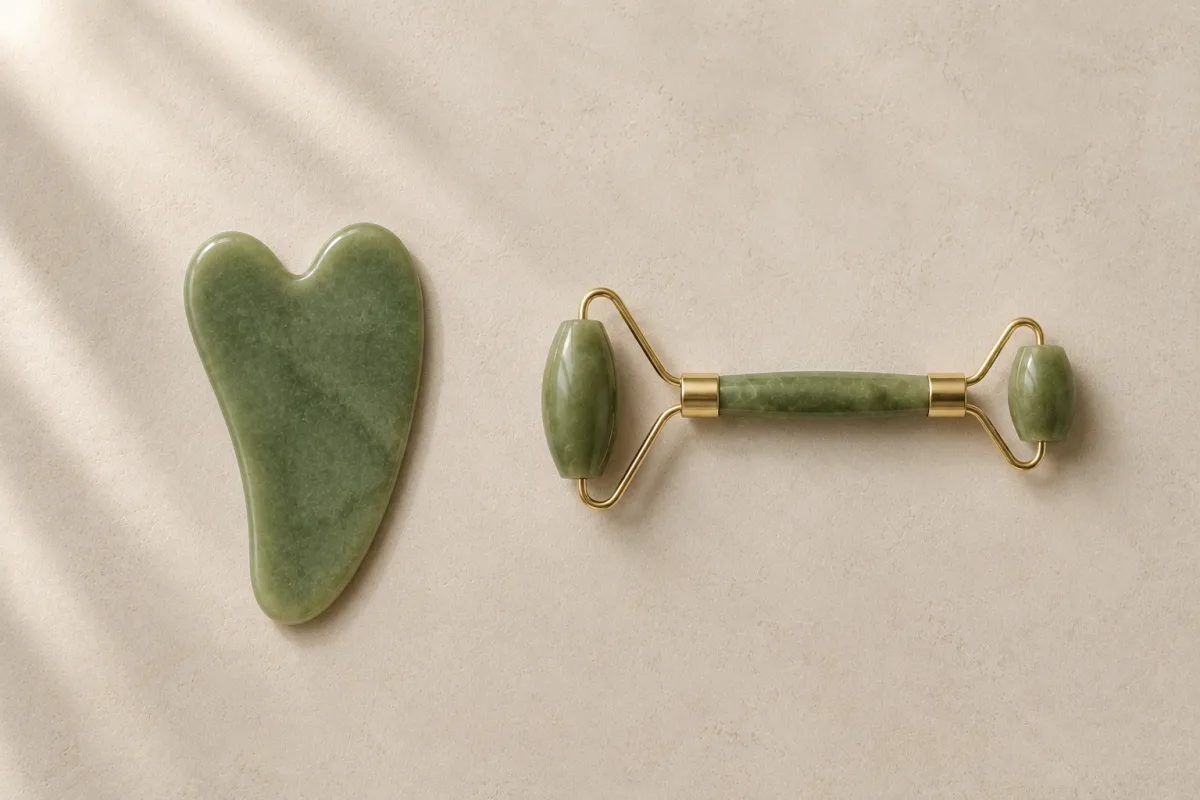
They aren’t two versions of the same thing, and there’s now trial data to say so. A randomized controlled trial put a flat stone and a roller through the same eight-week schedule and got measurably different results out of them. The stone moved muscle tone. The roller moved skin elasticity. Both reduced facial surface distance by about the same amount, which means the thing most people buy either tool for is the one thing that doesn’t separate them.
This page covers what that trial found, where the two tools actually differ once they’re in your hand, and which one suits which problem.
What the trial actually measured
The study appeared in the Journal of Cosmetic Dermatology in 2025. Thirty-three women aged 20 to 50 were split into a gua sha group of 17 and a facial roller group of 16. Everyone did ten-minute sessions five times a week for eight weeks, a target of 40 sessions each.
Facial contour: no meaningful difference between the tools.
- Gua sha: facial surface distances reduced 2.23–2.40 mm (p < 0.001)
- Facial roller: reduced 2.75–3.26 mm (p < 0.001)
- The difference between the two groups was not statistically significant
Both worked, and neither clearly beat the other. If contour is the whole reason you’re shopping, this is the part to remember, because it’s the part the marketing for both tools tends to skip.
Muscle tone: the stone, and only the stone.
In the gua sha group, oscillation frequency dropped 2.02 Hz (p < 0.001) and dynamic stiffness dropped 56.46 N/m (p = 0.002). The roller group showed no significant change on either measure in the same trial.
Skin elasticity: the roller, and only the roller.
Gross elasticity improved 8.6% in the roller group (p < 0.001) against no change in the gua sha group (p = 0.129). Biological elasticity improved 7.5% against no change in the same trial. Here the gap between the two groups was statistically significant.
So the honest summary is a split decision. They’re comparable on contour, the stone is ahead on muscle tone, and the roller is ahead on elasticity.
What that means in practice
If the thing bothering you is a jaw that feels clenched by the end of the day, the trial points to the flat stone. Reduced dynamic stiffness is the measurement that corresponds to muscle letting go, and the roller didn’t move it at all.
If the thing bothering you is skin that feels slack instead of tight, the trial points to the roller. It’s the only one of the two that improved elasticity.
And if it’s morning puffiness, either will do. Choose on the practical differences further down instead, because the data doesn’t separate them here.
Two cautions before you treat any of those numbers as settled. Thirty-three participants is a small trial. The authors also say directly that eight weeks was long enough to show a change, but not long enough to say whether it lasts once you stop. This is one good study rather than a body of literature, and it deserves to be read that way.
Where they differ in use
Some of these differences show up in the first minute. Others take a few weeks to appear.
| Flat stone | Roller | |
|---|---|---|
| Learning curve | Steeper. Angle and pressure are on you | Gentle. The head sets its own angle |
| Control | High. Vary pressure and press into one spot | Low. Even pressure, can’t be concentrated |
| Fastest over | Jawline, brow bone, orbital rim | Cheeks and forehead |
| Moving parts | None | Axle and hinge |
| Cleaning | One smooth object, washes completely | Seams at the head, oil collects |
Difficulty. The roller is considerably more forgiving, and it’s the reason most people should probably start there. A rolling head finds its own angle against your face. That designs out the two mistakes behind most beginner irritation: holding the tool too upright, and concentrating pressure into a line. A flat stone has to be held close to flat on purpose, for the whole session, every session. That’s a real difference in attention, not just in skill.
Control. The trade-off runs the other way, and it’s the more interesting half of the comparison. A flat edge lets you change pressure, angle and contact length as you go, and it lets you press into one specific spot along the jaw and stay there. A roller spreads even pressure across whatever it touches and can’t be concentrated anywhere. That’s almost certainly why the stone moved muscle tone in the trial and the roller didn’t.
Fit around the face. A roller covers cheeks and forehead quickly, but it’s a cylinder, and a cylinder doesn’t sit into a curve. A contoured stone edge does, which is why it’s faster along the jawline and around the brow bone. If you have a narrow nose bridge or deep-set eyes, check the width of any roller head before you buy. Buyers with smaller faces regularly report that a standard head is too wide to work in close to the nose.
Failure mode. This is the one that separates them over time. A stone has no moving parts, so the ways it fails are chipping and slow edge wear. A roller has an axle and a hinge, and that assembly is what gives out first. Squeaking is the usual early sign, loosening comes next, and on cheaper rollers the head eventually works free of the bracket. Anything with a mechanism in it is a shorter-lived object than something without one. That doesn’t make rollers bad, it just means you should expect to replace one sooner.
Cleaning. A stone is a single smooth object and it washes completely in about ten seconds. A roller has seams where the head meets the frame, and oil settles into them and stays. Neither is hard to look after. The roller simply asks for more attention, and the seam is also where the squeak starts.
The material question, separately
“Jade roller” is a shape and a material bolted together, and the two get conflated constantly. Material has nothing to do with the trial results above. What it does decide is how the tool survives being dropped, how it feels on first contact, and how easy it is to keep clean.
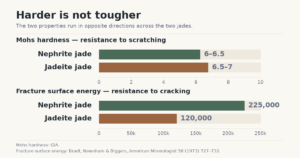
Hardness and toughness aren’t the same property, and the beauty category cheerfully merges them into “durable”. According to the GIA, hardness is resistance to scratching, while toughness is resistance to fracture. A stone can be excellent at one and mediocre at the other, and the two jades are a textbook case of exactly that.
On the Mohs scale, again according to the GIA, nephrite jade sits at 6–6.5 and jadeite at 6.5–7, while quartz, and rose quartz is crystalline quartz, is a 7. So quartz resists scratching slightly better than either jade. Toughness runs the opposite way and by a much wider margin. Mineralogists have measured this properly: nephrite’s densely matted fibers hold a spreading crack back roughly twice as well as jadeite’s blocky grains, which cleave straight through. Rose quartz has no fibrous structure at all.
In plain terms, drop a rose quartz tool and a nephrite tool on the same tile floor, and the softer stone is the one more likely to survive. Full figures and the source are on the tool shortlist, where the material comparison is set out in a table.
Stainless steel is a different case again. Steel has no single Mohs figure, because that depends on the alloy and its heat treatment. The grades used for kitchen and beauty tools generally sit below both stones, so a steel tool scuffs more readily. It doesn’t chip, and it’s completely non-porous, which makes it the easiest of the three to get properly clean. It also draws heat out of skin faster than these silicates do. That’s why a steel tool at room temperature feels cold the moment it touches your cheek, while a stone one feels closer to neutral. We’re deliberately not putting a number on that difference. The figures circulating in this category come from product copy rather than from measurement.
Which to buy
Buy the roller if you want the most forgiving option, your concern is puffiness or skin that feels slack, and you’d rather not think about technique while you’re half awake.
Buy the flat stone if your concern is jaw or temple tension, you want control over pressure and placement, or you want a tool with no moving parts to break.
Buy both only if you have a specific reason to. On contour, the outcome most people are actually after, the trial found no significant difference. A second tool buys you a second mechanism, not a better result.
Prices change constantly and we don’t list them, so check the current price at the retailer. We do not personally test or review every product featured on this website, and the material claims above come from published mineral data rather than from handling these tools.
Common questions
Can a jade roller replace gua sha?
Not entirely. In the 2025 trial the two came out level on facial contour, but only the flat stone changed muscle tone and only the roller changed skin elasticity. They overlap on the outcome most people buy for and diverge on everything else.
Which one should a beginner buy first?
The roller, in most cases. A rolling head sets its own angle, which removes the two mistakes behind most first-session irritation. A flat stone rewards attention, and it’s easier to start paying that attention once the routine itself is familiar.
Is real jade actually better than rose quartz?
For surviving a drop, yes, if it’s nephrite. Nephrite is the softer stone but much the tougher one, because its matted fiber structure resists a spreading crack. Rose quartz resists surface scratching slightly better and chips more easily. A listing that says only jade won’t tell you which one you are getting.
Why do rollers start squeaking?
The metal bracket is rubbing against the stone head, which is the most commonly reported roller complaint and usually appears after a few weeks of washing. A drop of oil where the head meets the bracket normally settles it. If the head is already loose, oil can let it work free instead, so check the fit first.
Should the tool be cold?
It doesn’t have to be. Cold is comfortable, and it’s not what produced the measured results in the trial, where neither group chilled anything. Steel feels colder than stone on contact because it draws heat out of skin faster, and every material warms to skin temperature within a few strokes.
How long before anything is visible?
The trial ran 40 sessions across eight weeks before it measured a change of roughly two to three millimeters in facial surface distance. Anything you notice in the first week is short-lived fluid movement rather than the effect that study measured.
Next: the sequence itself is in how to gua sha your face. A shortlist by material and shape is in best gua sha tools, and the wider context is on at-home facial massage. Our selection standard is in how a shortlist gets built here.
This page is general information and it is not medical advice. If you have a skin condition, or you’re unsure whether either tool suits you, ask your doctor before you start.