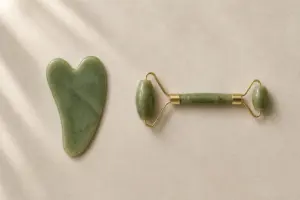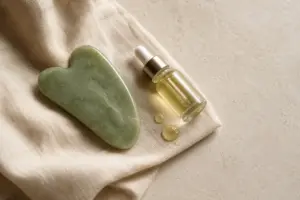
Most of the marketing in this category is about the aura of the stone. Look past the packaging and the experience comes down to four physical things: material, edge finish, shape, and whether the tool has moving parts that will eventually give out. The brand name on the box isn’t one of them, and this page works through all four before naming what we’d buy.
We do not personally test or review every product featured on this website. What follows comes from two places: published material data for the stones and steels involved, and what the listings and customer feedback for specific tools actually say. When a claim can be looked up, we name the source. When it would need us to have held the tool, we leave it out.
Disclosure: Some links below are affiliate links. If you purchase through one of these links, we may earn a commission at no additional cost to you. Affiliate relationships do not guarantee a positive recommendation.
As an Amazon Associate I earn from qualifying purchases.
What we’d buy, and who each one suits
Four picks, and they’re not four versions of the same thing. One is a starter set. One is a steel tool for the neck and shoulders. One is a cooling tool with no edge at all. And one is the oil that keeps any of them from dragging.
| Pick | What it is | Best for | The catch |
|---|---|---|---|
| BAIMEI IcyMe set | Rose quartz roller plus flat stone | Starting out, and anyone who wants both formats | Quartz chips more readily than jade, and the roller has an axle |
| Rylpoint steel scraper | One-piece stainless steel | Neck, shoulders and jaw, and anyone who wants no porous surface | Shaped for the body, not for the eye area |
| Prime Fitness ice globes | Two food-grade steel globes | Morning puffiness, and skin that reacts to pressure | No working edge, so it can’t do a gua sha stroke |
| Cliganic jojoba oil | Single-ingredient carrier oil | Slip, which every tool above needs | It’s a plain oil, not a treatment serum |
None of the four is nephrite jade, which is the material we’d pick for pure durability. There’s a reason for the gap, and it’s covered further down.
Material is the part you can actually check
Most guides in this category treat material as a matter of taste, or of crystal properties. It’s really a question of physics, and a fairly well documented one: three measurable properties decide how a stone tool behaves, and all three have been published.
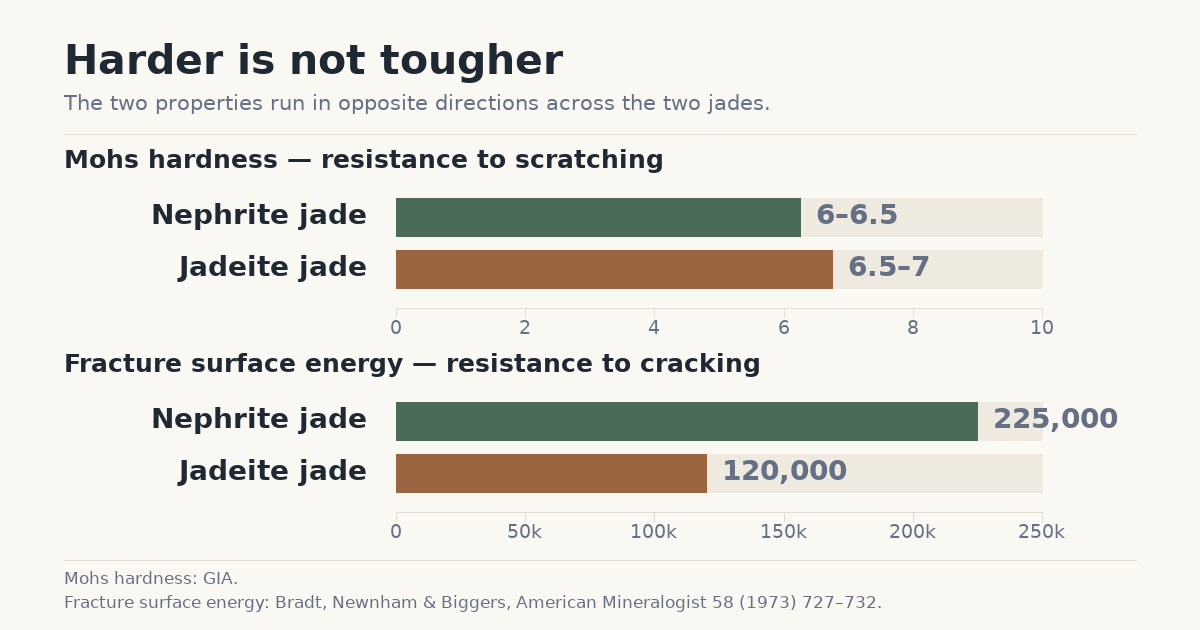
Hardness isn’t toughness. The GIA is explicit that hardness means resistance to scratching, while toughness means resistance to fracture, and that people mix the two up constantly. That matters here because the two jades land on opposite sides of it. The figure at the top of this page shows the split, and the table below puts numbers on it.
| Property | Nephrite jade | Jadeite jade | Rose quartz | Stainless steel |
|---|---|---|---|---|
| Mohs hardness, per GIA | 6–6.5 | 6.5–7 | 7 | no single value, since it depends on the alloy and its heat treatment |
| Fracture surface energy, ergs/cm², per Bradt et al. 1973 | 225,000 | 120,000 | no measurement by the same method | not comparable, since metal deforms instead of cracking |
| Porosity | slight | slight | porous | non-porous |
| Feels cold on contact | less | less | less | most |
Sources for that table: hardness from the GIA. Fracture surface energy from Bradt, Newnham and Biggers, American Mineralogist 58 (1973), pp. 727–732, measured by the work-of-fracture method on notched bars.
Hardness first, because it’s the simplest. On the Mohs scale nephrite jade sits at 6 to 6.5 and jadeite at 6.5 to 7, while quartz is a 7. So rose quartz is the hardest of the three stones, and it resists surface scratching a little better.
Toughness runs the other way, and not by a small margin. Mineralogists put both jades through the same fracture test, and nephrite held a spreading crack back about twice as well as jadeite did. That is the softer of the two stones winning on durability, which is exactly the confusion the hardness scale creates. Both, the authors noted, sit an order of magnitude above most commercial ceramics.
Electron microscopy showed them why. Nephrite is built from densely matted fibers that a crack can’t travel straight through, while jadeite’s blocky grains cleave right across. Rose quartz has no fibrous structure at all, which is the mechanical reason chipped corners keep turning up in reviews of quartz tools and rarely in reviews of nephrite ones.
There’s a mundane reason this matters more than it sounds on paper. You use these tools with oil on your fingers, standing over a hard sink, and a flat polished stone is exactly the shape that squirts out of a wet grip. Drop resistance isn’t a spec-sheet nicety here. It’s the difference between a tool that lasts years and one that lasts until the first slip.
Two honest gaps in that table. Nobody appears to have measured rose quartz or stainless steel by the same method, so those cells say so instead of borrowing a number from a different test. And we’re not putting figures on thermal conductivity. The values circulating in this category trace back to product copy, not to measurement. Published values for crystalline quartz also run high enough that the familiar “stone stays cool longest” line may have it backwards. Here’s what’s safe to say: metal pulls heat off skin faster than these silicates do, so a steel tool reads cold on contact and a stone one reads closer to neutral.
So: nephrite jade if you’ll drop it, rose quartz if you want the least scratch-prone surface, stainless steel if hygiene and lasting cold matter most.
Edge finish, the thing photos can’t show
Edge finish does more than material to decide whether a tool irritates your skin. It’s also the hardest thing to judge before you buy.
A good edge is smooth, with a slight radius where the flat face rolls into the working edge. A bad one has an abrupt transition, sometimes with a faint ridge left over from grinding, and that ridge catches. Product photography almost never resolves it, and no listing states it, so you end up judging edge finish from reviews instead of from the product page.
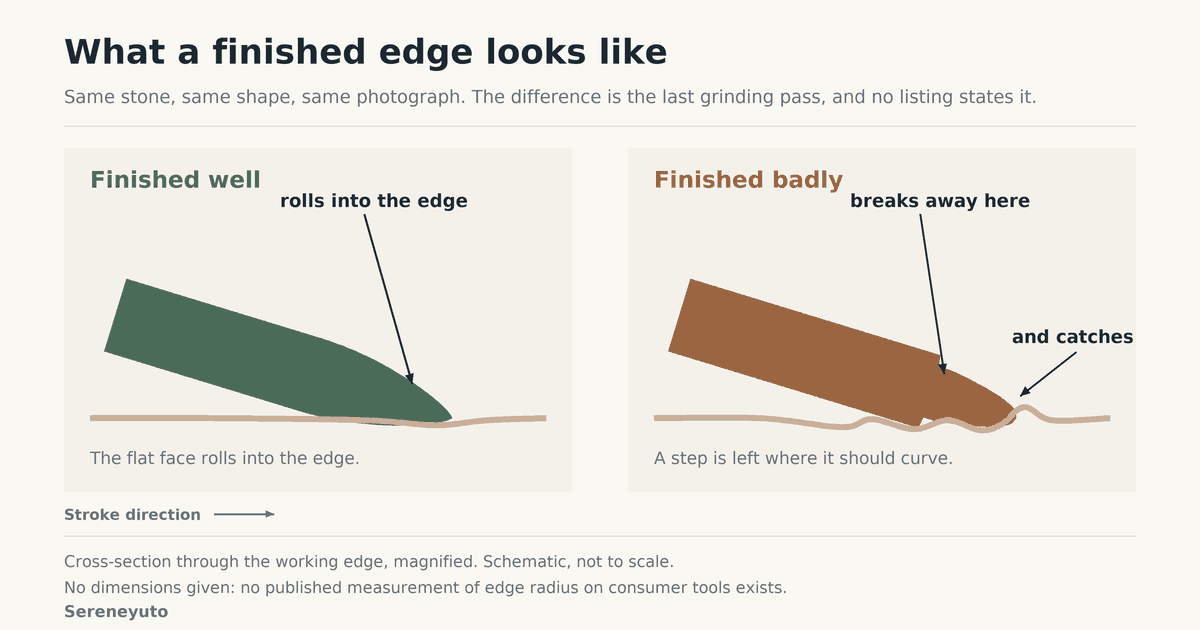
The workaround is the review pattern, not any single review. Repeated mentions of scratching, dragging or fine red lines from unrelated buyers usually point at edge finish. That goes double when those same reviews mention using oil. One-off complaints of the same kind usually point at dry skin and technique, which we cover in how to gua sha your face.
Shape: match your face, not the photo
Four features do real work here.
- A notch or deep curve on one side, so the jawline sits inside it. Without one, jaw work gets a lot less effective.
- A long shallow curve for the cheek and the side of the neck.
- A small comb or tapered end for the brow and around the eye socket.
- Overall size relative to your hand. Buyers say this directly and often, so look for reviewers who mention having small or large hands.
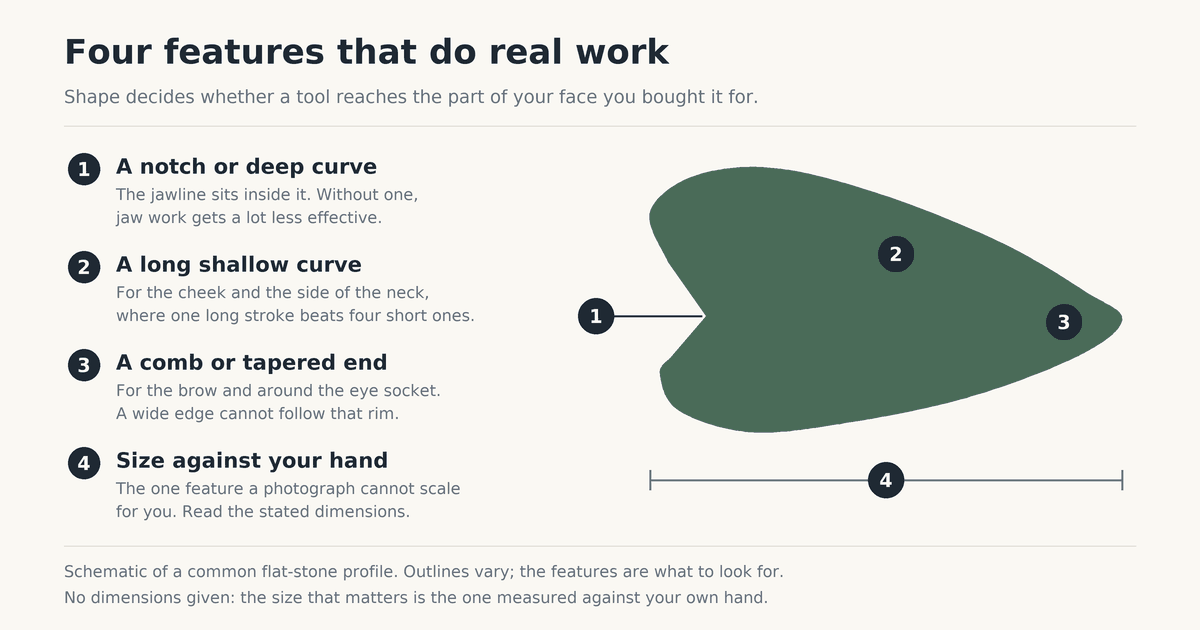
Weight and dimensions are on most product pages, and they’re worth reading before you buy. Too light and there’s nothing to work with, too large and the tool can’t follow the curve of the orbital rim or sit in close beside the nose.
Moving parts, and what breaks first
A flat stone has no mechanism, and its failure modes are cosmetic: chipping and edge wear. A roller has an axle, and the axle is what goes. It usually announces itself as a squeak first, then works loose, and on cheaper rollers the head eventually comes free of the bracket. That progression is the most consistent theme in roller feedback across brands and materials.
That’s a reason to expect a shorter service life, not a reason to skip rollers. A randomized controlled trial in the Journal of Cosmetic Dermatology in 2025 found the roller beat the flat stone on skin elasticity. Gross elasticity improved by 8.6%, while gua sha showed no significant change. Treat a roller as a consumable in a way a stone isn’t. Our roller versus stone comparison has the rest of that trial.
The picks in full
Starting out: BAIMEI IcyMe rose quartz roller and gua sha set
Check the current price and specs on Amazon
Two pieces, a roller and a flat stone, so you can find out which format you’ll keep reaching for before you spend more. That’s the main argument for a set at this level, and it’s a good one. The roller earns its place on the elasticity finding above, and the rolling head sets its own angle, which removes the two mistakes behind most first-session redness.
The stone is rose quartz, so it’s the most scratch-resistant of the three materials in the table and the most likely to chip if it lands on tile. Both of those trace back to the same physics: hard, with no fibrous texture to stop a crack.
One detail is worth knowing, and it’s the kind of thing this page exists to point out. The title says rose quartz. The listing’s own material field reads “Jade, Quartz, Stone.” That field isn’t a reliable way to tell what you’re getting, here or anywhere else in this category. The listing also suggests keeping the set in the fridge, which is sound advice for any stone tool and the cheapest way to get the cold effect.
What it doesn’t do: it won’t survive a drop the way nephrite would, and the axle will eventually be the reason you replace the roller rather than the stone.
Neck, shoulders and jaw: Rylpoint stainless steel gua sha scraper
See the full specifications and current price on Amazon
Steel answers the hygiene question in a way stone can’t. It’s non-porous, it has no seam for oil and skin cells to sit in, and it can’t chip. It also reads cold the moment it touches skin, for the reason in the material section.
Be clear about what this one is, though. According to the listing it’s a one-piece stainless tool weighing 2.4 ounces, written up for the neck, back and soft tissue instead of the face. Amazon files it under back massagers rather than skincare, so buy it as a neck, shoulder and jaw tool. It has an angled working edge, which is what those areas need, and the low weight keeps it controllable.
What it doesn’t do: it isn’t shaped for the eye socket or the brow, and steel gives you no cushion at all, so a heavy hand shows up faster. It also scuffs more readily than stone does, because most stainless is softer than quartz.
Morning puffiness: Prime Fitness stainless steel ice globes
Check availability and current price on Amazon
These aren’t gua sha tools, and we’re not going to pretend otherwise. They’re two smooth globes on handles. There’s no working edge, so the scraping stroke is off the table. What they do is deliver cold over a broad area with almost no pressure.
That’s the right trade for two groups: anyone whose main complaint is how the face looks first thing in the morning, and anyone whose skin flushes when a tool presses on it. According to the listing they’re food-grade 304 stainless steel with removable handles, and the pair weighs 10 ounces. A couple of hours in the freezer keeps them cold for a few hours after that.
What they don’t do: no edge means no jaw work and no fluid moved along a line, only cooling. And cooling is what you get, not a change to your skin. Anyone expecting the second thing will be disappointed by the first.
Slip: Cliganic organic jojoba oil
Check the current price on Amazon
The least interesting pick on the list, and the one that changes the most. A tool dragging on dry skin is the single most common cause of a bad first session, and the fix costs less than any of the tools above.
Jojoba is the sensible default because it’s boring. According to the listing this one is a single-ingredient oil, USDA organic certified, non-GMO verified, unscented, in a 4 fl oz bottle. Nothing in it competes with whatever else you already use, and there’s no fragrance to react to. A bottle that size outlasts a lot of sessions, since a tool needs very little.
What it doesn’t do: it’s a carrier oil, so it isn’t doing anything active for your skin on its own. If facial oils break you out, this one will too. Use a slippery serum instead, and skip acids on a day you plan to massage.
Why there’s no nephrite pick here
Nephrite jade is the material we’d name first for durability, and there’s a measured reason for that in the table above. We haven’t linked one, and the reason is worth stating plainly.
Listings in this category routinely say “jade” and stop there. Nephrite and jadeite are different minerals with close to a two-to-one difference in resistance to cracking, and plenty of what sells as jade is neither. The BAIMEI material field above is a live example of how vague that data gets. So the slot stays empty until we find a listing that names the mineral and holds up on the rest of the criteria here. An empty slot is more useful to you than a guess dressed up as a pick.
Making one last
Wash the tool with warm water and a mild soap after every session, then dry it properly. Oil and skin cells left on a tool are why it starts causing breakouts weeks later, not on day one. This is where non-porous surfaces earn their keep: steel and glazed stone wipe clean, while a joint or a hairline crack doesn’t.
Store a stone flat, not standing in a cup where it can tip onto a hard floor. If cold is what you’re after, the fridge is enough, and it’s gentler on stone than a freezer.
Replace a tool when the edge develops a nick you can feel with a fingernail, or when a roller starts to wobble on its axle. Neither is repairable, and both turn a smooth stroke into a dragging one.
What we’d skip
Tools sold mainly on the energetic or healing properties of the crystal, because there’s nothing in that claim to compare or check. Any listing that won’t state material and dimensions. And any set where the photographs are the only evidence the edge is finished properly.
Prices aren’t listed here. They move constantly, and a stale number is worse than none, so check the current price at the retailer before you buy. Commissions play no part in the criteria on this page, and the full terms on how affiliate links work here spell out the rest.
In short
Nephrite jade for durability, rose quartz for scratch resistance, stainless steel for hygiene and cold, and a roller if you want the easiest start. Edge finish beats material for comfort, and shape beats both for whether the tool reaches the part of your face you bought it for.
The step-by-step sequence covers technique. The wider at-home routine covers where a tool fits in the first place. And the criteria we hold products to covers the standard all of this is held to.
Common questions
Which material should you actually buy?
Nephrite jade if you expect to drop it, since it resists cracking better than anything else here. Rose quartz if a scratch-free surface matters more. Stainless steel if you want a non-porous surface and cold that lasts. Any of the three works on your face, and the differences show up in how the tool ages rather than in what it does on day one.
Is rose quartz better than jade?
It is harder, so it scratches less. It is also more brittle, so it chips more. Both come from the same property. If your tool lives on a bathroom counter above tile, that is an argument for jade rather than quartz.
Do you need the roller and the flat stone, or just one?
Just one, eventually. A set is useful at the start because you find out which format you keep picking up, and most people settle on one within a few weeks. The roller is more forgiving because the head sets its own angle. The flat stone lets you concentrate pressure, which is the whole point along the jaw.
Will a stainless steel tool scratch your face?
Not if the edge is finished properly and you use oil. Steel gives you no cushion, so a heavy hand shows up faster than it would with stone. Start lighter than you think you need to, and let the tool glide instead of pushing it.
Can you put these tools in the freezer?
The fridge is enough for stone and gentler on it. Steel globes are made for the freezer, and the listing gives a time for it. Skip repeated freezing for a roller with a metal axle if you want the axle to survive, and never put anything straight from a freezer onto broken or irritated skin.
Do ice globes replace a gua sha tool?
No. They have no working edge, so they cannot do the stroke that moves fluid along a line. They deliver cold over a broad area with very little pressure, which is a different job. Buy them for morning puffiness or for skin that flushes under pressure, not as a substitute.
What should make you skip a listing?
No stated material, or a material field that only says stone. No dimensions or weight. Product photos as the only evidence about the edge. And any listing whose main selling point is what the crystal is supposed to do rather than what the tool is.
This page is general information and it is not medical advice. If you have a skin condition, or you have recently had a cosmetic procedure, talk to a doctor before you start.