Leg & thigh care / Manual tools
Two people bought the same wooden roller. Six months later, only one was still using it.
For anyone whose legs feel heavy by the end of the day, and who already has a massage tool collecting dust somewhere.
Opens Amazon.com · Price and availability change often
Both of them were on their feet most of the day. Both felt it in the same two places, the front of the thigh and the back of the calf, usually right after they finally sat down. Both had already tried a foam roller and quietly given up on the getting down onto the floor part. Both read the same listing, looked at the same row of wooden wheels, and bought the same stick in the same week.
One of them still uses it, four nights out of seven.
The other one’s is behind the door in the spare room.
Neither of them decided it was junk. That’s the part worth sitting with. Nobody made a decision to stop. One kept reaching for it and one kept not reaching for it, and after a few weeks that stopped being a choice and started being a fact.
The one who quit had been using it on their back.
The difference
So what actually separated them?
Not discipline. Both of them meant to. Not free time, they had about the same amount, which is to say not much. Not pain tolerance either, because the one who quit was pressing harder, not softer.
It came down to something smaller, and much less flattering to the whole self improvement story. One of them was using the tool where it actually works. The other wasn’t.
A roller stick is a tool you hold in both hands. That single sentence decides almost everything about whether it stays in your life.
Two hands on a stick means you can only work on what your hands can get to while your arms still have leverage. Front of thigh, outer thigh, calf, forearm. Your own mid back is not on that list and never was. It isn’t a flaw in the product. It’s geometry.
So the difference between the person who kept it and the person who shelved it was one decision made on night one, and it took about four seconds: legs, not back.
What it actually is
Here’s the part nobody explains before you buy
A foam roller works by putting your body weight on top of it. You lie down and gravity does the pressing. A roller stick flips that around. The pressure comes from your arms, so you control it directly and you can stop the second it’s too much.
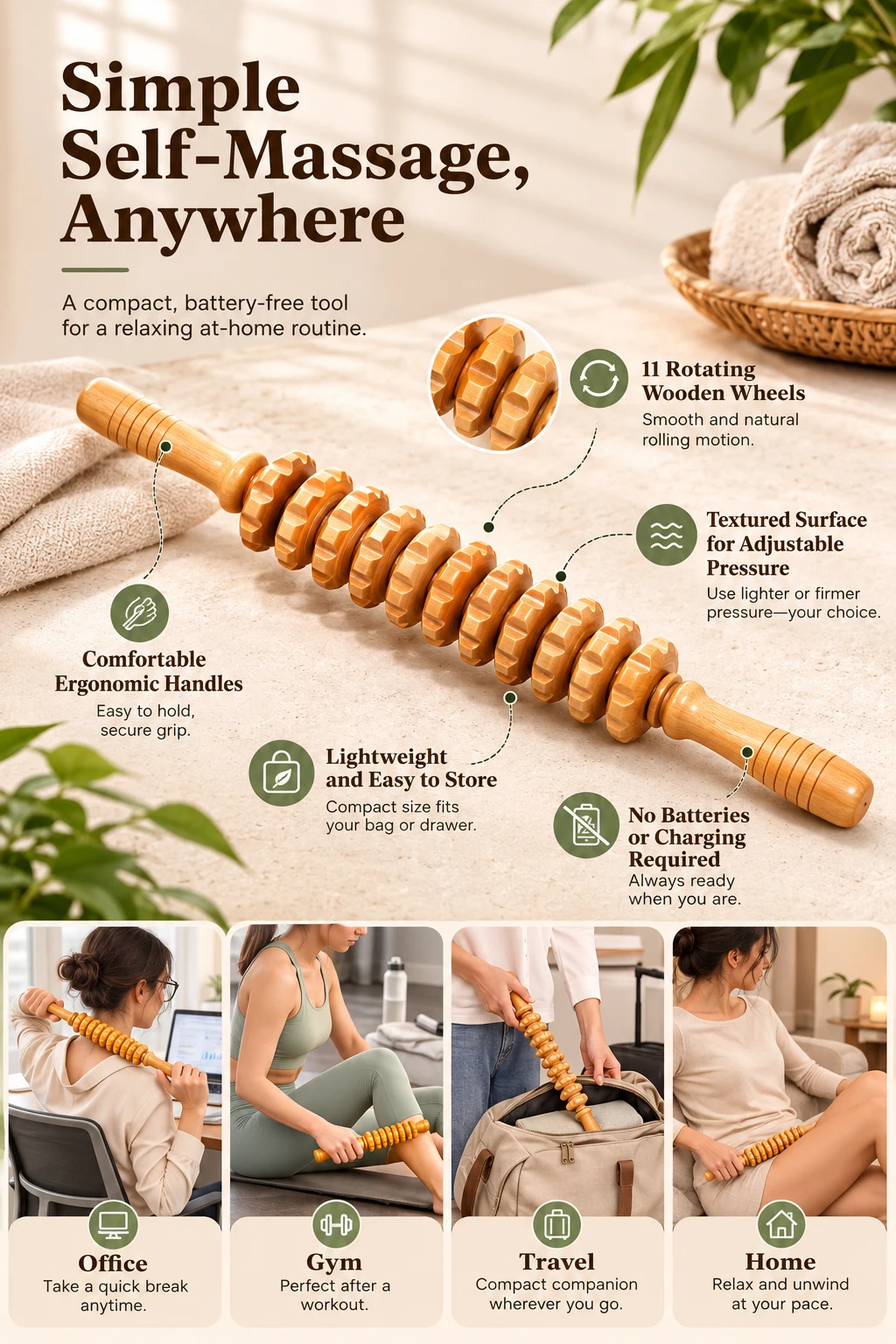
The wheels change how it lands. Each wooden ring touches a smaller area than a foam roller does, so even a light pass can feel surprisingly firm.
And wood doesn’t compress. Foam absorbs some of what you put in. Wood returns all of it. Which is why the reviews praising the pressure and the reviews complaining about it are usually describing the same tool, used two different ways.
It’s worth being specific about the back, because that’s where most of these end up failing. To roll your own back you have to reach behind you. Your arms are at their weakest angle, you can’t see what you’re doing, and you end up shoving hard to feel anything at all. The stick isn’t the problem there. The reach is.
- Product
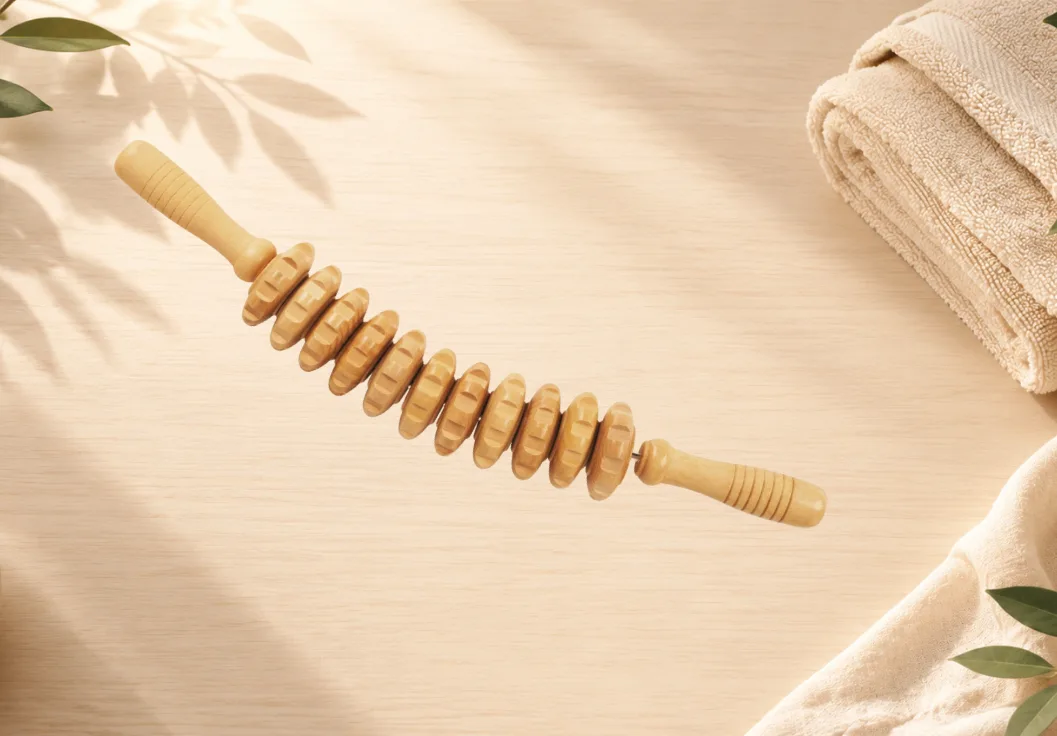
- Handheld wooden roller stick, 11 wheels
- Brand
- Liitrton
- Type
- Manual roller. No battery, no motor
- Material
- Wood
- Length
- 19.69 inches, about 11 ounces
- Intended areas
- Thighs, calves, forearms
- Category
- Health & Household
- Price & rating
- See the current figures on Amazon
We don’t print prices or star ratings here. Both move constantly, and the only number that matters is the one on your screen at checkout.
What actually matters in a roller stick
Three things matter. Long enough to span a thigh. Light enough your arms don’t quit first. Rigid enough to track straight.
19.69 inches, about 11 ounces, per the listing. That’s roughly a full mug of coffee, and that weight is the number that decides whether you’re still doing this in week three.
How we cover products
A note on how we review products
We research listings, specifications and buyer feedback. We do not personally test or review every product featured on this website.
From the listing: on Amazon since 2018, rated 4.4 out of 5 at the time of writing, across well over three thousand ratings.
- Product details come from the current Amazon listing.
- We describe what a product physically does, and we don’t repeat marketing claims we can’t back up.
- We make no medical claims and we promise no results.
- We’re not licensed healthcare providers.
- We disclose every affiliate link.
- Check the live listing before you buy. Sellers and specs change.
The part the listing doesn’t come with
Four rules, in order
- Legs only for the first week. Front thigh, outer thigh, calf. A minute per leg.
- Work upward. Knee to upper thigh, ankle to knee. Ten slow passes.
- Start lighter than you think. You can always add more pressure.
- Pick a moment, not a time. Right after you take your shoes off.
Two minutes, standing at the edge of the bed. No floor involved, which is why it survives.
Opens Amazon.com · Check the size variant before you order
Buyers describe the wood as smooth and easy to hold. One reviewer put it bluntly: very little for your back, but the outer thigh works well.
One tip: read the one- and two-star reviews first. On something this simple, they tell you the real failure modes in about ninety seconds.
The part other pages skip
Who should skip this
- Your own mid back.
- No leverage there with a two handed tool. Use a hook, or a ball against a wall.
- If you press hard.
- Handle durability is a negative theme in Amazon’s own review summary, and one reviewer describes the handle screwing off. It’s an assembled wooden tool at an entry level price. Treat it like one.
- If you want something hands-free.
- It only works while your arms do.
If you want one
The listing shows a free 30 day return window. That’s Amazon’s policy, not our promise. The button below goes to Amazon, where you can see the current price, the shipping, the seller, and whether it’s actually in stock.
And if you’ve read this far and decided no, good. That’s a real outcome, and we’d rather you keep your money than buy a stick that ends up behind a door.
Other tools in this collection
Different jobs, same collection. Here is when each of these makes more sense than the one above. We research products and shortlist them; we do not personally test or review every product featured on this website.
High density foam roller The Original Body Roller
Choose this one if you would rather use your body weight than your arms, and you have floor space to lie down on.
Acupressure mat and pillow set ProsourceFit
Choose this one when you would rather lie still than work at something. It reaches the whole back, which no two handed tool can.
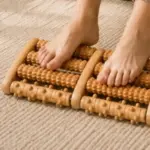
Wooden foot roller for end-of-day feet TheraFlow
Choose this one when the part that complains is the underside of the foot, not the leg above it. It sits on the floor and your own weight does the work, so nothing is asked of your arms.
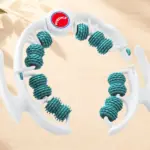
Ring roller for all-round calf tightness MZDXJ
Choose this one when a calf feels tight the whole way around rather than in one stripe. The ring closes on it from several sides at once, so you stop chasing the sore spot with one face of a tool.
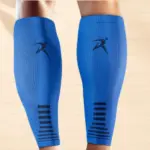
Calf compression sleeves Rymora
Choose this one if you want something you wear through the day rather than a tool you pick up for two minutes at night.
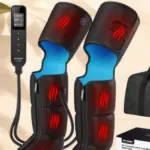
Powered leg wrap for too-tired-to-move evenings FIT KING
Choose this one for the evenings when working on your own legs is itself the obstacle. You sit, it runs, and it is the only item here that needs an outlet.